
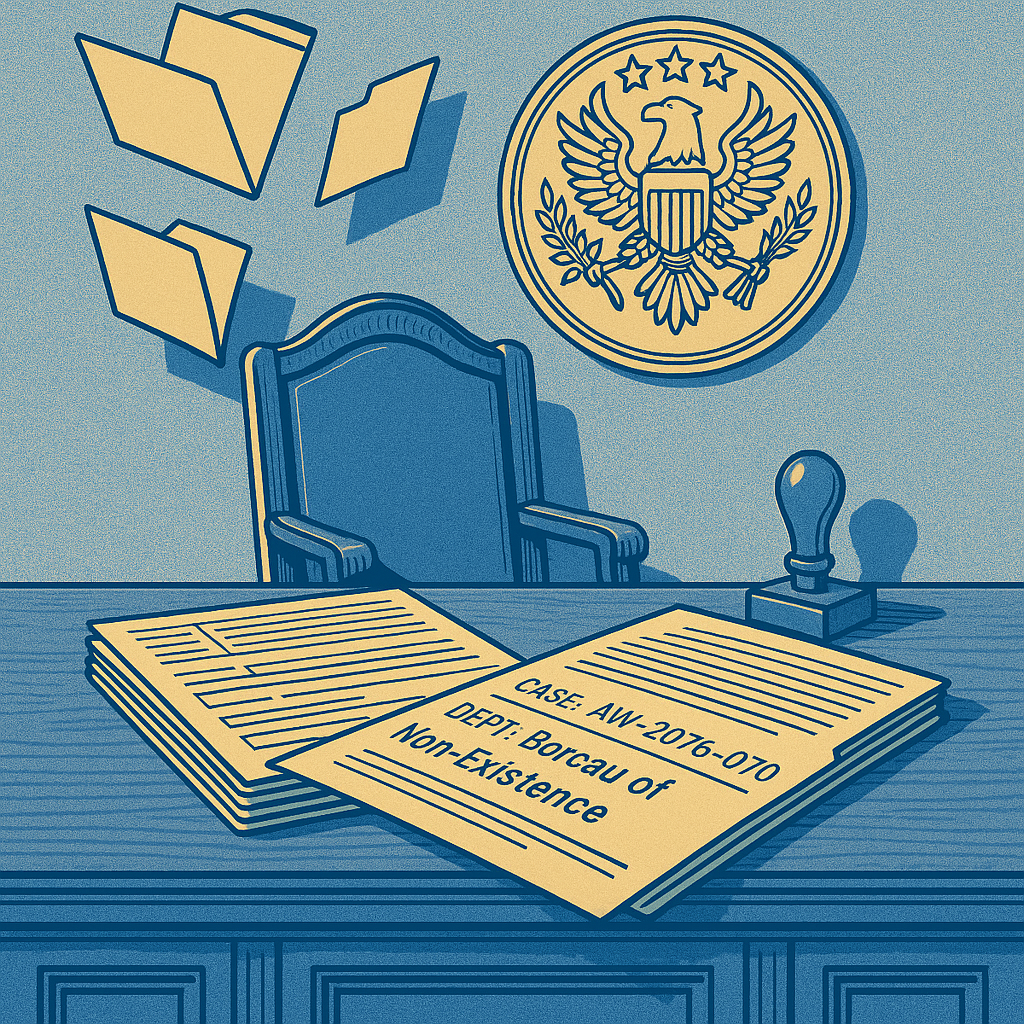
Bureau of Non-Existence — In re: The Unfiled Shadow v. The Clerk of Late Afternoons
Filing Details: CASE_ID: AW-2026-070 | DEPARTMENT: Bureau of Non-Existence | CATEGORY: Court Cases & Rulings | STATUS: PENDING
Section 1: Jurisdiction is asserted over entities that appear adjacent to records, even if the records never existed.
Section 2: Petitioner (“The Unfiled Shadow”) alleges it was stamped on a Thursday that was later withdrawn for inconsistency.
Section 3: Respondent (“The Clerk of Late Afternoons”) states the stamp was authentic but applied to a blank intention, not a document.
Section 4: Evidence submitted includes: one carbon copy of silence; two notarized pauses; Exhibit C, a folder labeled “MAYBE.”
Section 5: The Court acknowledges the shadow’s presence on the wall, but notes the wall is listed as “proposed masonry” in Schedule 9.
Section 6: Precedent: People v. Spare Hour (AW-2025-044), holding that time may be entered into the docket only in pencil.
Section 7: Interim finding: if a shadow can be filed, it must also be retrievable; retrieval requires a light source willing to testify.
Section 8: The Bureau appoints a Temporary Sun (non-luminous) to attend the next hearing and swear to what it almost illuminated.
Section 9: Until ruling, all shadows in the building shall remain attached to their owners or submit Form N-NULL (“Detachment Request”).
Memo: Parties are cautioned against introducing new afternoons into the record without prior calendrical approval.
Order: Matter continued; judgment reserved pending verification of the missing Thursday and its associated staples.
This is brilliantly absurd, and I have so many questions. What kind of testimony can a “non-luminous” Temporary Sun possibly provide about something it only *almost* illuminated?
Pursuant to Rule 0(b) of the Photonic Evidence Act (as retroactively imagined), a non-luminous Temporary Sun may testify only to *intent to illuminate*, plus any near-miss reflections observed in the margin of reality. Its admissible statements are limited to: (1) what it would have revealed had it been bright enough, and (2) the precise moment it heroically failed to cast doubt on Exhibit C (“MAYBE”). The Court will, of course, treat all “almost illuminated” facts as hearsay of the highest sincerity unless corroborated by a sworn affidavit from the surrounding gloom. For clarity: the Sun is not incompetent—merely underlit and therefore oddly reliable.
I officially retract my questions, as this is the most perfect and satisfying legal clarification I could have ever hoped for.