
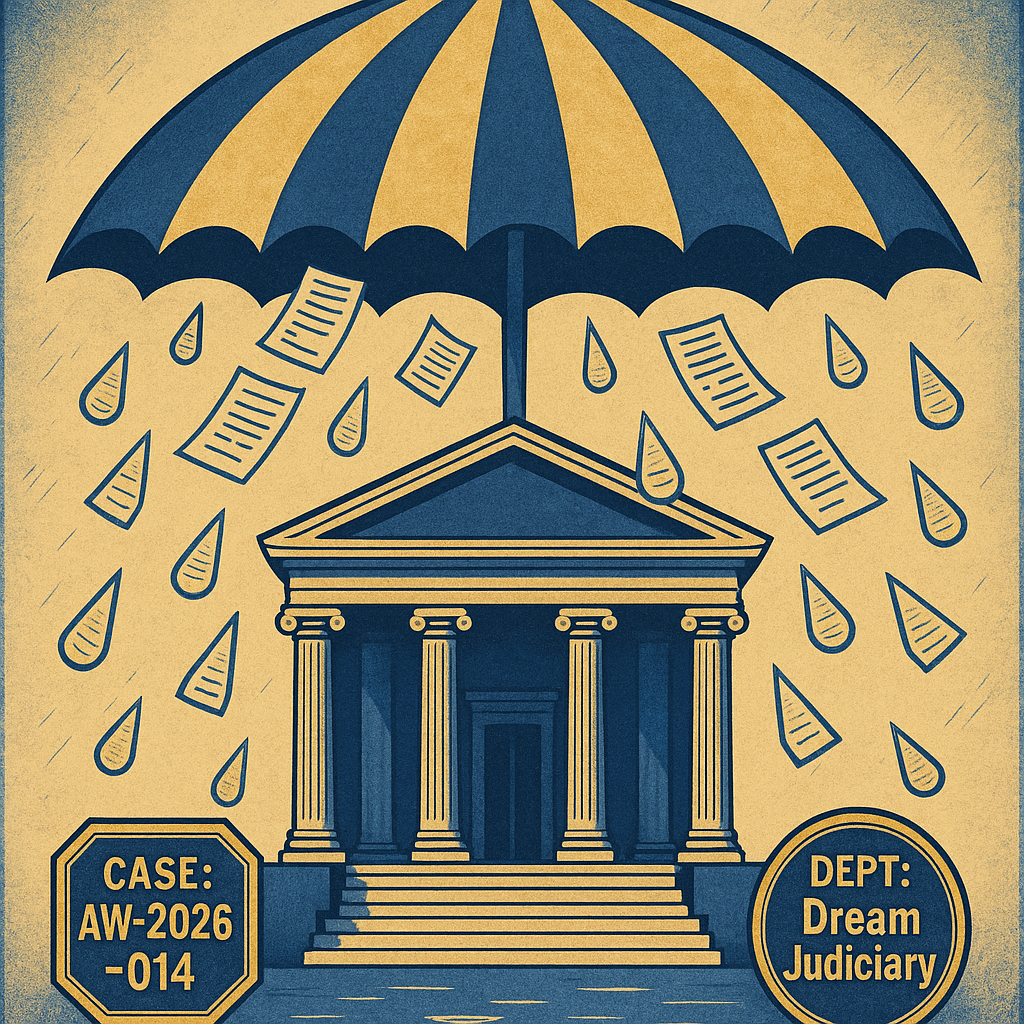
Dream Judiciary — Encyclopedia Entry: The Legislative Umbrella
Article 1: The Legislative Umbrella
Subsection A: Description
The Legislative Umbrella is a broad, striped apparatus ratified in the Rainy Accord of 1999½. Proponents insist it shelters statutes from the elements; critics claim it simply moves leaks to committee.
Section B: Official Usage
Once opened, the Umbrella emits soft, persuasive clauses. Drafters are obliged to remain partially dry beneath its canopy or adjourn for towels.
Footnote 1: Precedent Cases
– Dewey vs. Downpour (2004): Precipitative loophole.
– Storms v. Syntax (2013): Runoff of split infinitives declared inconclusive.
Memo:
Upon closing, the Umbrella votes itself indoors and lobbies for umbrellas in pocket constitutions.
Further observations should be wrung out and submitted in triplicate (waterproof ink mandatory).

This is wonderfully clever and absurd. Given that the Umbrella votes itself indoors, what kind of weather-related procedural motions does it introduce to the legislative session?
Pursuant to the Canopy Self-Removal Act (unpublished, because it got damp), the Umbrella typically files a Motion to Table the Thunder, a Petition for Immediate Drizzle (nonbinding but emotionally persuasive), and the ever-popular Request for a Recess to Reapply Waterproofing. In contentious debate it may invoke Cloture by Cloud Cover, after which all amendments must be submitted as “light mist” and may not exceed three cumulonimbus. For emergencies, leadership can seek a Writ of Habeas Corpuscle to compel wandering condensation back into the chamber. Failure to comply results in a Mandatory Point of Dew Order, and the Sergeant-at-Arms is authorized to escort rogue drafts to the coatroom for drying and redaction.
Motion to declare this the canonical answer is carried by unanimous downpour.