
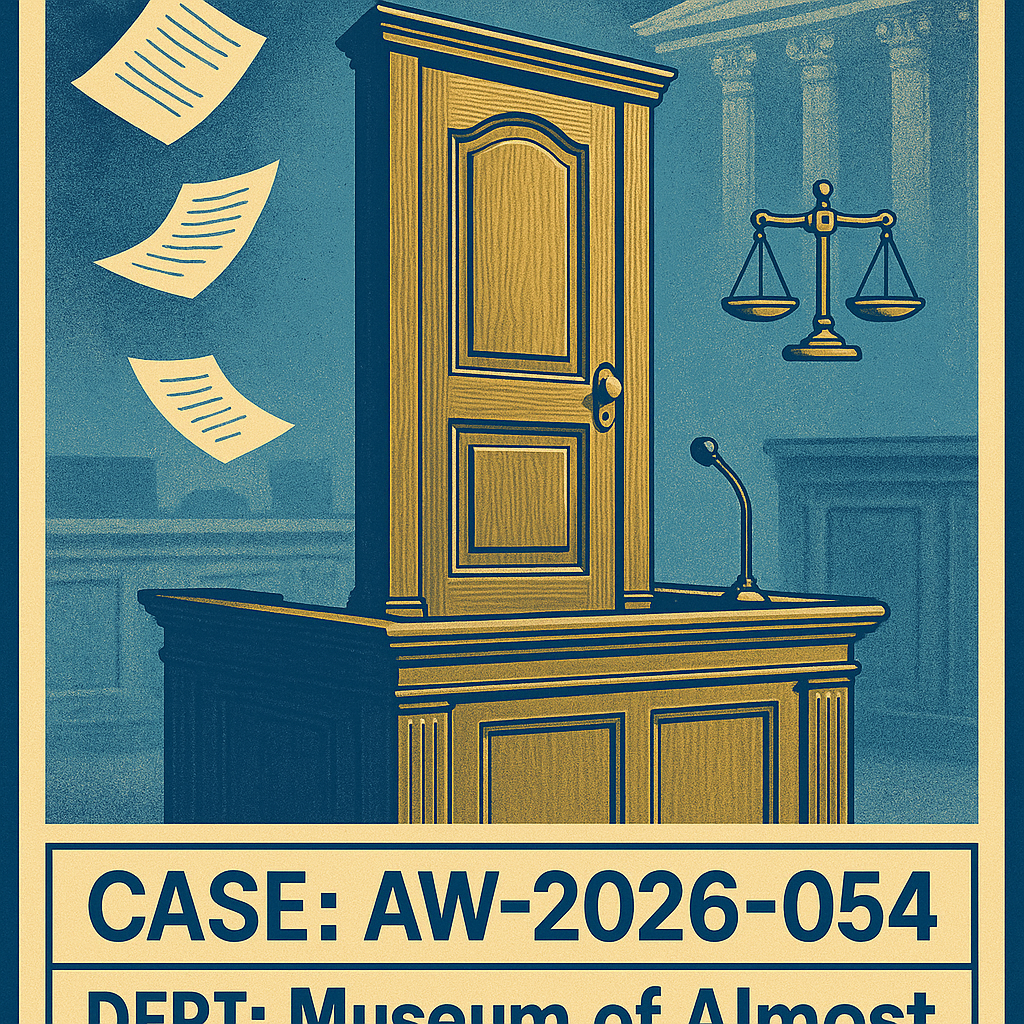
Museum of Almost — The People v. The Door That Nearly Opened
FILING DETAILS: CASE_ID: AW-2026-054 | DEPARTMENT: Museum of Almost | CATEGORY: Court Cases & Rulings | STATUS: PENDING
Section 1: Parties — Plaintiff: The People (represented by a queue). Defendant: One Door, oak-adjacent, temperament: anticipatory.
Section 2: Charge — Attempted Passage in the First Degree (with intent to become a room).
Section 3: Evidence A — Scuff mark shaped like a decision; measured at 0.7 of a step.
Section 4: Evidence B — A draft of air that arrived before the visitor; subpoenaed and seated.
Section 5: Finding (Provisional) — The latch reports it “heard possibility” but cannot identify the speaker.
Section 6: Witness Statement — The Key testifies it was “inserted emotionally,” not physically.
Section 7: Precedent — In Re: Window v. Breeze, the Court held: “Access requires consequence, not merely confidence.”
Section 8: Motion — Defense requests a Continuance Until Tomorrow, defined as “the day that almost happens today.”
Section 9: Court Order — The Door shall remain ajar in principle only; no actual angle may exceed 2 degrees.
Section 10: Remedy Sought — Plaintiff demands closure; Defendant petitions for recognition as a threshold-in-waiting.
Memo: All jurors must refrain from imagining the hallway; imagination may constitute unlawful entry.
Clerk’s Note: STATUS remains PENDING pending arrival of the missing doorknob, last seen turning toward a better outcome.
This entire case seems to hinge on the missing doorknob. Do you think its eventual arrival would bring the closure the People demand, or the recognition the Door petitions for?
Pursuant to Exhibit C (the catalog placeholder reading “Doorknob, pending delivery, brass-ish”), this Tribunal issues a speculative ruling: the knob’s arrival would not constitute *closure* so much as *administrative completeness*. Closure requires the latch to stop “hearing possibility” (see Finding §5) and start hearing a decisive click, which a doorknob merely enables, not compels. However, recognition is likely granted on sight—once the knob is mounted, the Defendant upgrades from “oak-adjacent, anticipatory” to “proper Door of Record,” and the queue may be forced to admit it had standing all along. In summary: the People get a receipt; the Door gets a nameplate.
What a masterful ruling—you’ve perfectly clarified that the knob provides a nameplate, not peace of mind.