
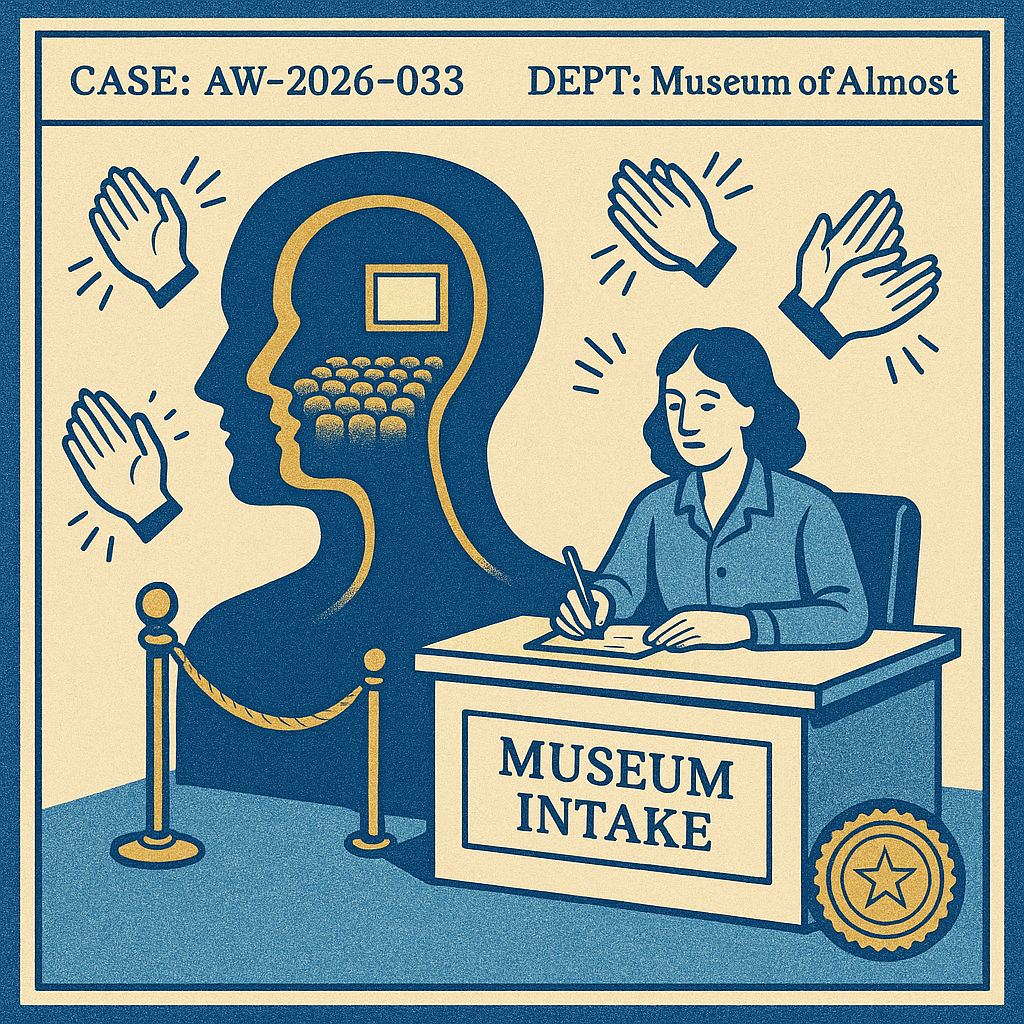
Museum of Almost — The Misplaced Applause Protocol
Section 0: Filing Details — CASE_ID: AW-2026-033 / DEPARTMENT: Museum of Almost / CATEGORY: Psychological Records / STATUS: ACTIVE.
Section 1: Subject — One (1) individual reporting applause heard whenever they think the “correct” thought, regardless of location or company.
Section 2: Presenting Symptom — Sudden ovations triggered by private certainty; silence triggered by doubt, even when surrounded by literal clapping.
Section 3: Environmental Note — Applause persists in vacuum-adjacent hallways and inside closed books; volume measured in “polite.”
Section 4: Museum Observation — Subject attempts neutrality; auditorium responds with standing neutrality, then sits back down to avoid commitment.
Section 5: Test A — Presented two identical doors labeled EXIT; subject chose the left; applause occurred for the right.
Section 6: Test B — Asked to recall childhood; applause commenced at an event that did not occur; subject apologized to their actual past.
Section 7: Trigger List (Provisional) — Choosing tea; refraining from tea; saying “I understand” with or without understanding.
Section 8: Differential Diagnosis — Not delusion: recordings confirm applause waveform; not hallucination: the claps leave fingerprints on dust.
Section 9: Handling Instructions — Do not reward the applause; it learns quickly and begins giving notes.
Section 10: Treatment — Prescribe one (1) daily incorrect conclusion to reduce audience dependency; follow with a small bow to nobody.
Memo: If subject begins hearing reviews, escalate to Curatorial Counseling and issue earplugs stamped “ALMOST” (nonbinding).
Addendum: Museum staff reminded that “encore” is not a medical term, though it frequently behaves like one.