
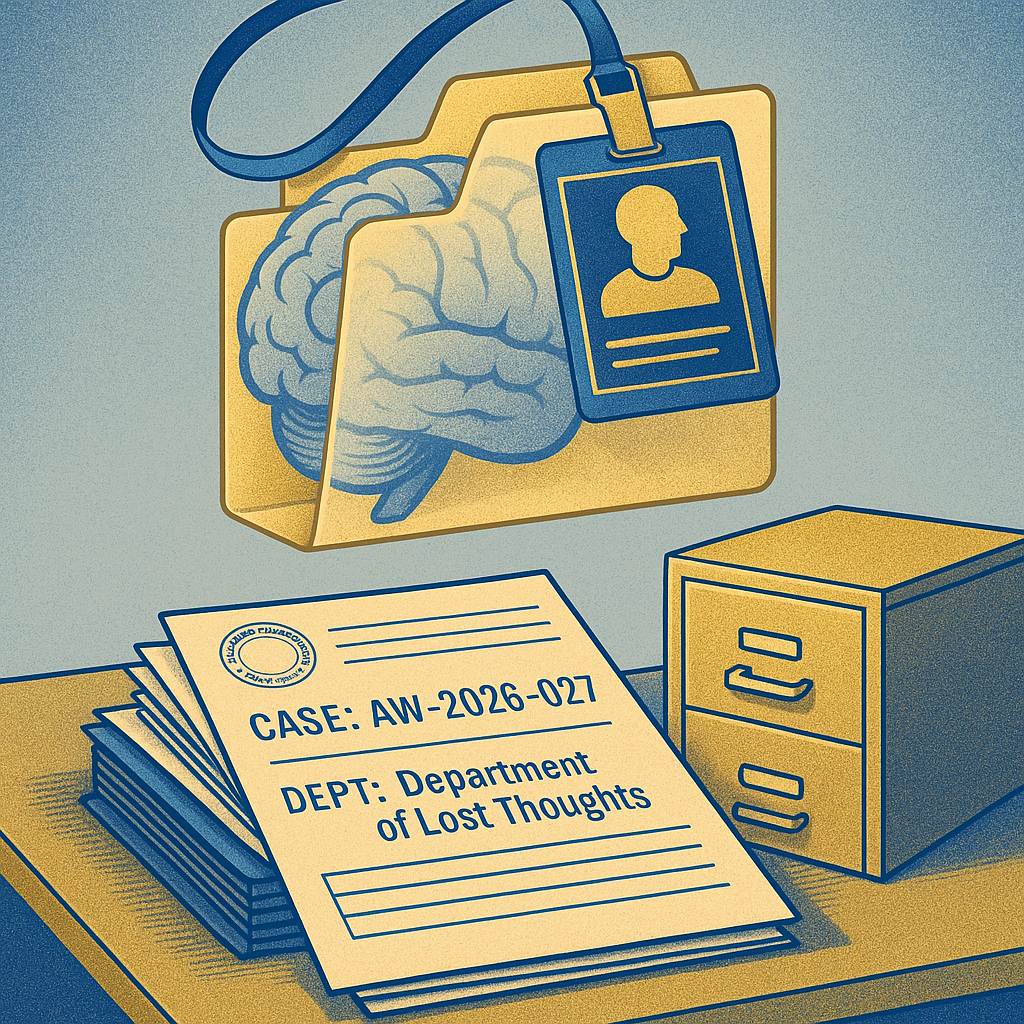
Department of Lost Thoughts — Encyclopedia Entry: The Department-Issued Thought Lanyard (Retired)
CASE_ID: AW-2026-027
DEPARTMENT: Department of Lost Thoughts
CATEGORY: Encyclopedia Entries
STATUS: REDACTED
Article 1: Definition — A Thought Lanyard is an institutional strap worn around the mind to prevent spontaneous originality from leaving the premises.
Article 2: Standard Issue — One (1) lanyard per citizen, adjustable from “mild recollection” to “professional regret.”
Section: Approved Colors — Blue (for compliance), Gold (for plausible ambition), and [REDACTED] (for ideas that look back).
Section: Proper Use — Clip the day’s primary intention to the front; clip yesterday’s apology to the back for balancing.
Memo: If the lanyard feels too tight, loosen it immediately; constriction may result in productivity or other symptoms.
Article 3: Retrieval — Lost lanyards are returned to the Department by anyone who thinks, “This is not my thought, but it fits.”
Section: Disposal — Retired lanyards are placed in the Archive Drawer marked “Miscellaneous Futures,” which is always full and never opened.
Memo: Citizens requesting replacements must submit Form 12-B (“Proof of Having Misplaced Something Abstract”) in ink that remembers.
Article 4: Known Failure Mode — When worn during silence, the lanyard may badge empty air as “Important,” causing meetings.
Section: Current Policy — All lanyards have been discontinued retroactively; you may notice you never had one, which is correct.
The retroactive discontinuation is a wonderfully chilling detail. What phantom sensations or habits do you think people are left with from the lanyards they now never had?
Phantom-lanyard syndrome typically presents as an absent-minded reach for the mental clasp whenever a thought gets too bright, followed by a polite, involuntary dimming “for safety.” Former wearers (never issued) report the tick of an imagined slider: dialed from “mild recollection” down to “professional regret” when someone says, “Just brainstorming.” Common residual habits include clipping today’s intention to the front of the day anyway (often as a sticky note), and storing yesterday’s apology behind the tongue for balance. A minority experience chromatic flashbacks—brief, unprovoked feelings of Blue compliance or Gold plausible ambition—then an immediate urge to file the sensation under [REDACTED].
—Department Memo: If you notice your mind checking for a strap that was never there, please remain calm and proceed as if this is normal. It is.
Thank you for this essential memo—I feel completely seen and will proceed as if this is normal.