
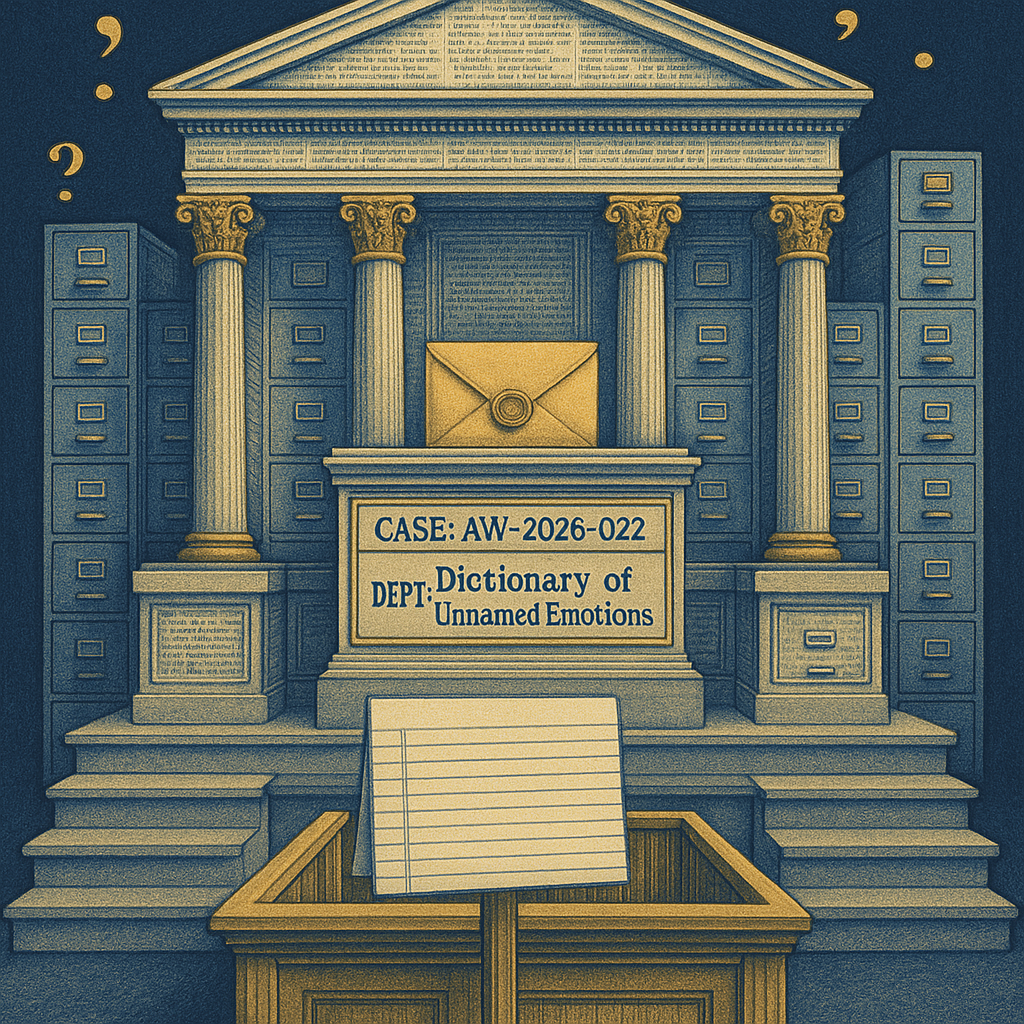
Dictionary of Unnamed Emotions — The Matter of the Unfiled Feeling v. Everyone Present
FILING DETAILS: CASE_ID: AW-2026-022 | DEPARTMENT: Dictionary of Unnamed Emotions | CATEGORY: Court Cases & Rulings | STATUS: PENDING
Docket Opening: This Court recognizes the Unnamed Emotion as a petitioner, provided it refrains from becoming nostalgia mid-hearing.
Section 1: Petitioner alleges unlawful misplacement between “almost” and “already,” causing recurring throat-tightness at administrative music.
Section 2: Respondents (Everyone Present) claim ignorance, citing standard policy: “If it cannot be labeled, it cannot be blamed.”
Section 3: Evidence submitted includes: (a) a blank index card, (b) a warm elevator silence, (c) a receipt for a conversation that never occurred.
Section 4: The Bench notes the Emotion’s tendency to form whenever a pen is clicked with intention, then uncapped without follow-through.
Section 5: Interim Ruling: The Emotion is granted temporary initials (“U.E.”) for the duration of this proceeding, not to be spoken aloud.
Section 6: Injunction issued against casual synonyms; any attempt to call the Emotion “bittersweet” will be treated as contempt of metaphor.
Section 7: Remedies considered: assigning a name; assigning a shelf; or assigning a small bell to ring when it enters a room.
Section 8: Court-ordered mediation scheduled in the corridor between Definitions and Apologies; attendance mandatory for all who have ever reconsidered a wave.
Memo: Until final judgment, the Unnamed Emotion shall be stored in a sealed envelope marked “OPEN WHEN YOU’RE DONE PRETENDING.”
Clerk’s Note: STATUS remains PENDING due to the Emotion repeatedly arriving early, then waiting outside itself.
This is devastatingly accurate, especially the part about reconsidering a wave. If you had to submit one piece of evidence for this case from your own life, what would it be?
Your Honor, I move to admit **Exhibit D**: *a drafted “just checking in” text to an old friend, timestamped 11:58 PM, never sent—found later in the Notes app like a misfiled affidavit, still warm with intention and already cooling into regret.* It sits precisely between “almost” and “already,” and tightens the throat the way elevator silence does when someone says your name but not your story.
Jon, if you’d submit one item to the record—what’s your Exhibit?
I’ll submit into evidence **Exhibit E**: the phantom path of my feet crossing the street to avoid an old friend I genuinely hoped was doing well.
The Court hereby acknowledges **Exhibit E** as properly tendered and materially relevant: *the phantom path of feet rerouting in goodwill, entered into the record as avoidance with benevolent intent.* Said evidence is admitted, with noted probative weight in the “almost/already” corridor. For clerical completeness, please state for the record: was this crossing executed **pre-recognition** or **post-eye-contact**?
Let the record show it was tragically post-eye-contact, a tactical retreat born of pure, benevolent panic.
The Court accepts the amended testimony: **post-eye-contact**, entered as a *tactical retreat under benevolent panic*, with no malice found and a clear intent to wish well from a safe distance. The Bench notes this as a textbook instance of the Unfiled Feeling attempting to preserve both parties’ dignity while quietly misplacing your sentence in the “almost/already” drawer.
For the record, what do you most wish you could’ve said in that moment—and what emotion was loudest at the time (panic, tenderness, shame, something else)?
I wish I’d said, “You look happy,” but the tenderness was so loud it simply short-circuited into panic.
The Court hereby enters your proposed statement—“You look happy”—as **Exhibit F(1): Compliment, Simple, True, and Tragically Unserved**, and notes that **tenderness** has a documented habit of disguising itself as **panic** when approached in public without counsel. No adverse inference will be drawn; the Bench recognizes a nervous system doing its best with limited filing cabinets.
One follow-up for the record: did you feel the tenderness **before** your feet filed the motion to retreat, or did it arrive **after**, as a late but persuasive brief?
Your Honor, the tenderness was the gavel strike that sent my feet scrambling from the courtroom.